
Why I picked it
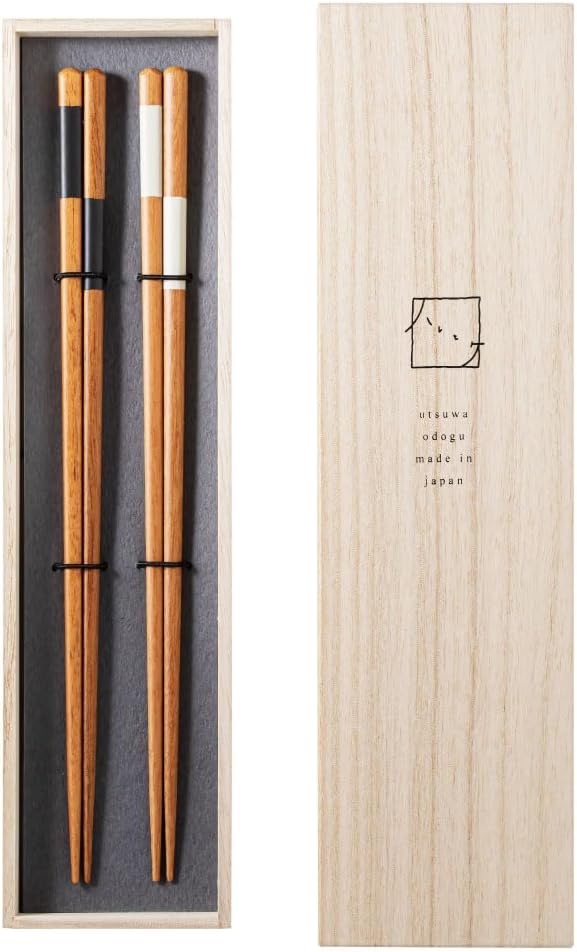
I picked it for a wedding or housewarming present that gets used, not kept in a cupboard. These chopsticks are made for daily meals, so once the wooden box is open, both pairs can go straight onto the table.
There’s also no size to choose. The length is based on hito-ata-han, a traditional Japanese measure taken from the body, and suits men and women alike, so the same chopsticks work for both people you give them to.
- Non-slip tips. The chopsticks are slim, and the tips have a non-slip finish, which the maker says makes food easier to pick up.
- Antibacterial and dishwasher-safe. They are treated with Zeomic, an inorganic antibacterial agent, and can be washed in a dishwasher.
Choose this if you’d like Wakasa lacquered chopsticks for everyday meals, one pair with a white band and one with a black band, in a wooden box. Choose the Shiki Moku Zen spring chopsticks if you want a seasonal gift: cherry-wood chopsticks tied with mizuhiki (a decorative Japanese cord), in a paper box with a spring scene.
In my set for the table, I put them next to the Hasami cat chopstick rests.
Keep in mind
- Safety: thin tips. The tips are slim, and the maker asks for extra care when children use them.
- Not in the box: chopstick rests. The box holds the two pairs of chopsticks and nothing else.
- On Amazon: other versions on the same page. The Amazon Japan page lists many other choices, such as single pairs in other colors, hand-carved chopsticks, Noto hiba wood chopsticks, chopstick rests and serving chopsticks. This one is the wooden box with one white-band pair and one black-band pair (checkered white and black). The same page also has a wooden-box set of two pairs in white and black (NOG-297-WB-2).
Details
One pair of chopsticks, 22.5 cm (8.9 in) long
A bank card, 8.6 cm (3.4 in)
Drawn to scale against each other.
- Model
- NOG-297-ICWB-2.
- Maker
- &NE, a brand of n.elephant Co., Ltd., based in Osaka.
- Japanese name
- Wakasa-nuri Hashi, Kibako-iri, Hare to Ke, Ichimatsu Shiro-Kuro, 2-zen (“Wakasa lacquered chopsticks in a wooden box, Hare to Ke, checkered white and black, 2 pairs”).
- In the box
- Two pairs of chopsticks, one with a white band and one with a black band, held on a gray lining in a wooden box.
- Care
- After meals, rinse them in hot or cold water and dry them with a soft cloth. Avoid scrubbing brushes and scouring powder. Keep them away from direct sunlight, since it may bend them or change their color. Replace a pair soon if it cracks or breaks.
- Sources
- &NE’s product page for the single pair (Japanese) · n.elephant’s company page (Japanese) · the product description in the maker’s own online shop (Japanese) · Obama City on its traditional industries (Japanese) · JR West’s English travel page on Wakasa Obama.