
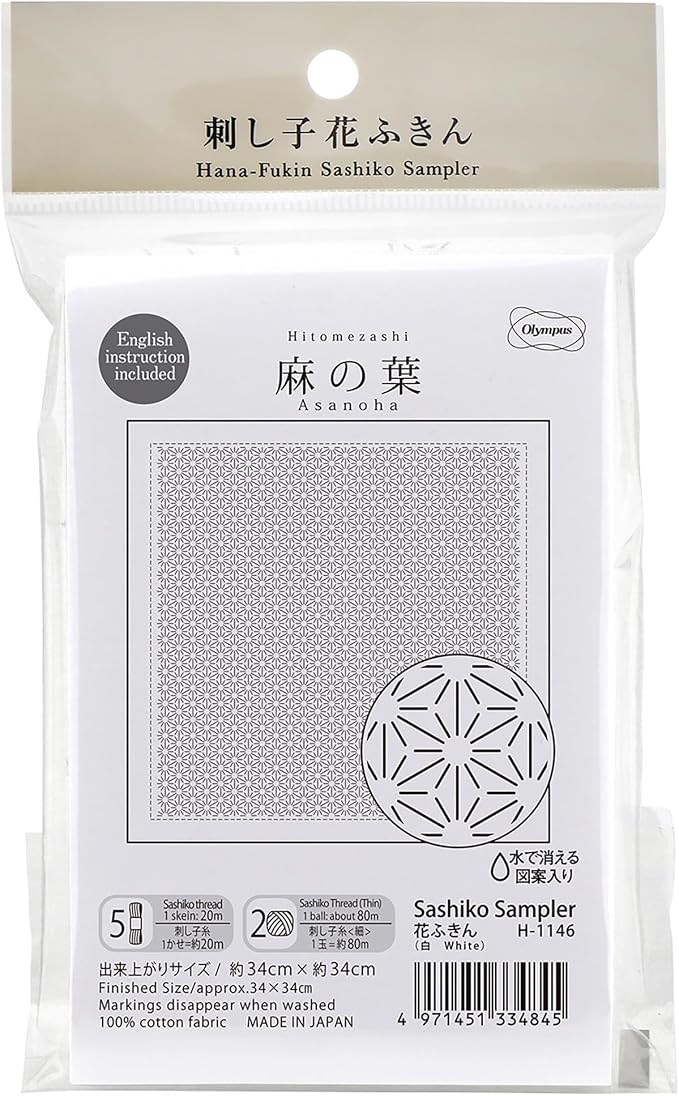
Why I picked it
I picked it for a sashiko stitcher (sashiko is a Japanese style of embroidery) who would like one cloth to stitch on their own, in any thread and any colors they like, as the maker describes it.
- No tracing, and no lines left at the end. The pattern is already on the cloth, so there is nothing to copy onto it, and the printed lines disappear when you wash the finished cloth.
Choose this if your sashiko thread and needle are already at home, and hemp leaves are the pattern you want. Choose the SK-493 kit from the same maker if you’d like sashiko thread and a sashiko needle in the bag, with chrysanthemums to stitch.
Keep in mind
- How much thread to buy. The pack gives a guide: 5 skeins of sashiko thread (about 20 m, or 22 yd, each), or 2 balls of the thinner sashiko thread (about 80 m, or 87 yd, each). Per Amazon Japan, also have sewing thread, a sewing needle, scissors, an iron and a ruler ready.
- The instruction language is listed two ways. The front of the pack says “English instruction included.” The maker’s online shop lists the instruction sheet as Japanese.
Details
Finished size: about 34 × 34 cm (13.4 × 13.4 in). The flat cloth in the pack is larger.
A bank card, 8.6 cm (3.4 in)
Drawn to scale against each other.
- Model
- H-1146, barcode (JAN) 4971451334845. Look for H-1146 in the Japanese title on Amazon Japan. The maker’s shop also has H-1124, another white asanoha sampler; this page is for H-1146.
- Maker
- Olympus Thread Mfg. Co., Ltd., in Nagoya, founded in 1908. The company says it made the first Japanese embroidery thread.
- In the box
- White sarashi cotton cloth with the pattern printed on it, and an instruction sheet.
- How it works
- The pattern is printed on one half of the cloth, and the other half is plain, as in the main photo. The cloth is not pre-made. A sashiko shop’s guide to the maker’s Nagomi samplers, which are made the same way, says to fold the cloth and sew it into shape, then stitch the pattern through both layers.
- Stitching time
- 18 hours or more, per Amazon Japan.
- Pattern
- Asanoha means “hemp leaf.” Hemp grows tall and straight with little care, so the pattern was often used for babies’ and children’s kimono, as a wish for them to grow well. Each star in the pattern is twelve triangles that form six diamonds around a center.
- Care
- The same guide says to keep the cloth dry until you finish stitching, and not to iron it before washing, because heat may make the printed lines permanent. To remove the lines, it says to soak the cloth in lukewarm water for a few minutes, then rinse.
- Sources
- The maker’s official online shop, H-1146 page (Japanese and English) · Olympus Thread’s company profile · the package, as shown in the Amazon Japan photos · the Amazon Japan listing (things to have ready, stitching time) · a sashiko shop’s guide to the maker’s Nagomi samplers (steps, care) · nippon.com (Japanese, on the asanoha pattern) · the Japanese American National Museum (shape of the pattern).