
Why I picked it
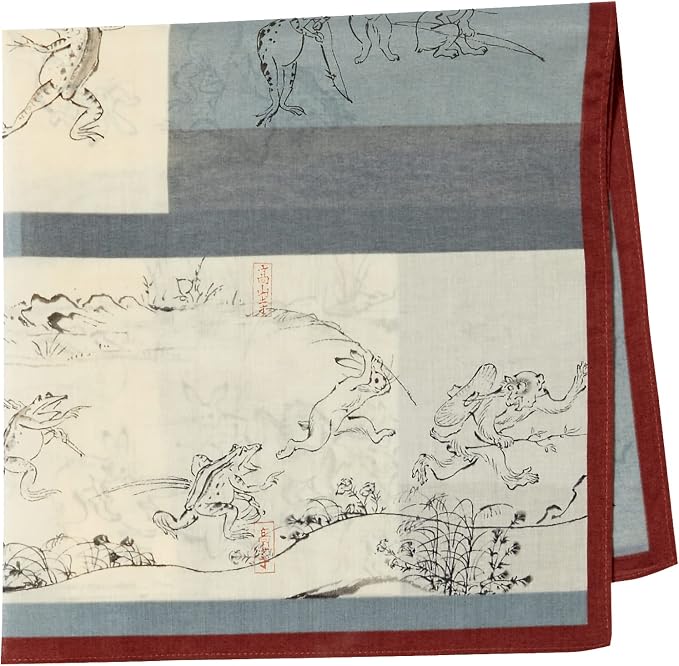
I picked it for people who love the animals of these old scrolls and want them on a cloth to carry and use. Four cream-colored panels with rabbits, frogs and monkeys inside them sit on a bluish-gray background, with darker gray squares here and there and a deep red hem around the edge. Folded, it goes in a pocket or bag. Opened up, it’s a large square, big enough to use as a placemat or to wrap a lunch box, per Japanese product listings.
- Thin, light cotton lawn. Lawn is a fine, plain-weave cotton; the maker describes this one as thin and light, and pleasant to the touch.
Choose this if you want the scroll’s animals in fine lines. Choose the Hanaguruma handkerchief if you want flowers and one spot of embroidery, from the same maker.
Keep in mind
- One side or both? Not stated by the maker. In the first photo, the design shows faintly on the back of the folded corner.
Details
Each side of the square, about 47.5 cm (18.7 in), longer than the long side of A4 or US letter paper
A sheet of printer paper (about A4 / US letter)
Drawn to scale against each other.
- Model
- 26-18-1605 in the maker’s catalog, part of its Kyosai series. In the catalog, the letter C stands for gray. The wholesale number is 12101-1605-C. Japanese name: 山本仁商店 京彩 鳥獣人物戯画 ハンカチ Cグレー.
- Maker
- Yamamoto Jin Shoten started out in Mino (now Gifu Prefecture) in the 1700s. In 1920 it opened a branch in Muromachi, Kyoto, and later moved its head office there.
- In the box
- One handkerchief.
- Pattern
- The design comes from the Choju-jinbutsu-giga (often shortened to Choju-giga), four picture scrolls handed down at Kozan-ji, a temple in Kyoto. They were made over the late Heian and early Kamakura periods of Japanese history. The maker notes that they are sometimes called Japan’s oldest manga. The design is printed (textile printing), not embroidered; the maker prints each handkerchief one at a time and then sews it.
- Sources
- The maker’s catalog, Irodori Vol. 26 (PDF, Japanese) · the maker’s company page and history page (Japanese) · the maker’s wholesale listing (fabric, pattern and printing) · Waraku on the Choju-giga scrolls (Japanese) · Japanese product listings (hem color, uses) · Amazon Japan’s product photos.