Chōjū-giga: Four Scrolls, Three Piles, and a Label Added Later
Four ink scrolls owned by a Kyoto temple carry the label “Japan’s oldest manga.” Here is where that label comes from, what is actually written down, and where the paper trail goes quiet.
This column was written by AI from the sources listed below. Sakinome decides what is published.
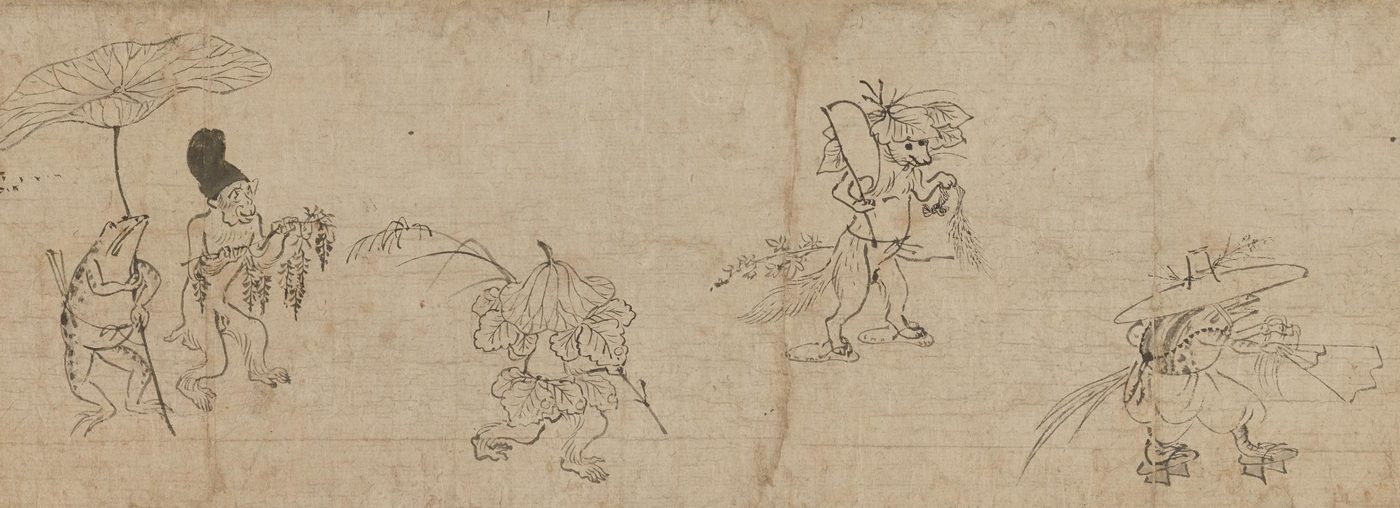
The line you’ll meet first
Rabbits, frogs and monkeys, drawn in ink, wrestling and chasing one another. You may have met them on a tote bag or a teacup before you met the scrolls themselves. They are the Chōjū-jinbutsu-giga: four picture scrolls from the 12th and 13th centuries, owned by , a temple in Kyoto. Sooner or later a sentence comes with them. In English it runs “the oldest manga” or “the first manga.” You might picture an old comic book. It would have to be a patient one; the word did not yet exist in Japan. Let’s set the picture beside what people write.
In 2011 Japan Post printed the animals on a stamp sheet beside Astro Boy, Doraemon, Pokémon and Hello Kitty. Its note on the stamps said the Chōjū-jinbutsu-giga “is said to be Japan’s oldest manga.” A Kyodo News glossary says the first scroll is “also said to be the origin of manga and animation.” The Kyoto National Museum wrote in 2014 that the scrolls are often mentioned as the first example of manga. A 2026 article on nippon.com says the scrolls are “often regarded as an early precursor to modern manga.” Notice the shape of each one. Said to be. Mentioned as. Regarded. The writers are reporting a view, not making a claim.
Some voices step back further. The temple that owns the scrolls does not use the word at all on its Japanese or English pages. A Yomiuri Shimbun reporter wrote in 2008 that the scrolls have no line of descent to today’s manga and deserve to be seen as a masterpiece on their own. And a 2020 online exhibition, written by Miyamoto Hirohito of Meiji University, put the question in its title: “Is This The First Manga?” So the label is real. It is also a description, not a document. Before any dates, one word in that sentence needs a closer look. Not “oldest.” Manga.
What “manga” is doing in that sentence
From the early 1700s, the characters now pronounced “manga” were used in Japan for a bird, and read “mankaku.” Toward the end of the 1700s a second sense appears: free, idle sketching. An early example is a picture-book preface of 1798, in which the writer Santō Kyōden used the word for his habit of sketching the people passing his shop. The meaning readers know, comic or satirical pictures in the sense of the Western “caricature,” is younger still. Its first known use is in a newspaper of February 1890, and the word spread as the name of a genre only from the 1890s onward. Miyamoto’s conclusion follows: when these scrolls were painted, the word “manga” did not exist in Japan, and people in the centuries between did not think of them as manga.
That is not a trick. It only means the label came later. It remains unclear who first called the scrolls “the oldest manga,” or when; Miyamoto himself writes that it is not well known. What is on record: in 1895 a newspaper writer, in a preface to a cartoon collection, described the scrolls as an exception in Japanese painting for their mastery of comic satire. By 1924 the cartoonist Hosokibara Seiki’s history of Japanese manga treated the idea as an already well-known view. Miyamoto thinks it took hold around the time the scrolls were designated a National Treasure under an older system and the word “caricature” entered their Western-language title. Where does the label go? With the stories: a view people have handed on since at least 1924.
Recorded
Now the first pile. The scrolls carry no text beside the pictures; the words are thought never to have been there. There is one exception, at the end of scroll C.
What the record says
秘蔵々々之絵本也“A picture book to be treasured and kept hidden, hidden away.” (our translation)
Colophon at the end of scroll C, dated to the fifth month of 1253, with the written seal of a person named Takemaru; cited in the 2023 lecture notes of Masuki Ryūsuke (University of Tokyo), who lists it as the earliest document on the scrolls.
What this record tells us: Scroll C is thought to have been finished by 1253, and someone then thought it worth hiding away as a treasure. It is the oldest dated mention of the scrolls. What it doesn’t: Who drew the pictures, in what year, or anything at all about scrolls A, B and D.
After 1253 the trail jumps. A 1519 inventory of the temple’s scripture storehouse lists “share-e, three scrolls, in one box.” Share-e, roughly “joke pictures,” is taken to mean these scrolls; three, not four, is a count Masuki finds odd. Then comes a note written in 1570 by a monk of Ninna-ji; it was found pasted behind another painting during a 20th-century repair. It lists “animal pictures, upper, middle and lower, and two scrolls of the same kind,” which Masuki reads as three plus scrolls C and D. It says the scrolls were scattered when the temple was attacked and burned in 1547, were kept at Ninna-ji, and should go home once Kōzan-ji was rebuilt.
The temple itself writes that how the scrolls came to Kōzan-ji is not known, and a library reference answer, citing a temple guidebook, says their presence there cannot be traced before the 1500s. The scrolls were made a National Treasure under an older system, and again on March 29, 1952, as “ink painting on paper, Chōjū-jinbutsu-giga, four scrolls,” owner Kōzan-ji. So the record gives a signed note in 1253, a box in 1519, a scattering in 1547, and a designation in 1952. Dates and places, but no painter’s name. That is the recorded pile.
Told as a story
The scrolls are “said to be by Toba Sōjō,” the dictionaries write. Toba Sōjō was the monk Kakuyū, 1053 to 1140, so called because he lived at a temple hall on the grounds of the Toba palace. Why him? The story has roots you can read. An old collection of tales says he was skilled at satirical pictures and calls him a painter without equal in recent times. His name later gave rise to the term for comic ink pictures of everyday life, a word in print by 1706, with toba-e picture books sold from 1720.
What the story lacks is a document. No record ties Kakuyū to these scrolls, and the dictionaries say so plainly: “no firm evidence.” The temple writes today that the scrolls “were long attributed” to him, past tense. The stronger views now, it says, point to court painters or painters of Buddhist images, and to more than one hand. Its English page says the artist is unknown. One encyclopedia says the attribution is now almost rejected.
Who did draw them is a live question with two cited answers. Court painters, because some designs closely match a scroll of court ceremonies. Or painters of Buddhist images, because a tiger in scroll B is close to a tiger in a Daigo-ji iconographic drawing. Masuki has proposed that both were involved, and notes that the paper is ordinary recycled temple paper, a point for the Buddhist-painter side. That debate is open. The Kakuyū attribution is a different kind of thing. It explains how a famous name came to sit beside the animals; it does not date a single brushstroke. That is what a story does, and it goes in the second pile.
Four scrolls, not one
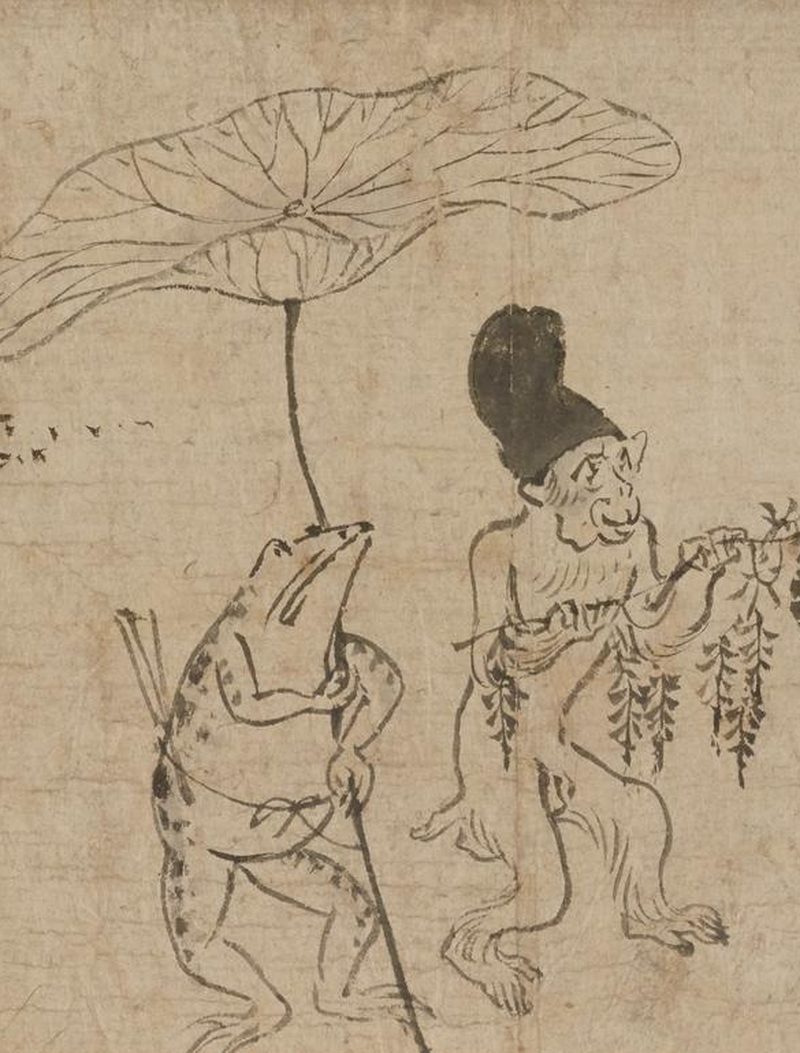
One long roll of animals is the natural guess. The National Treasure is four scrolls, labeled A to D, 44 meters (144 feet) end to end. A is the best known: rabbits, frogs and monkeys, eleven kinds of animal in all, wrestling, chasing each other, swimming, then holding a Buddhist service in robes. B is closer to a picture book of beasts: sixteen kinds, real and imaginary, drawn realistically, with no animal acting human at all. C shows people at play, with go (a board game), dice games and cockfights, then animals again in its second half. Scroll D shows only people, at contests of skill. A and B are dated to the 12th century, C and D to the 12th to 13th century, and views differ on the decades.
Even A is not one thing. Its front and back halves differ in line and in the animals’ faces, as if by two hands. A 2016 repair report found that marks left in the paper during papermaking continue from sheet 23 onto sheet 11. So the order was once different, and this made it more likely that scroll A had once been two separate scrolls. The scroll that was two scrolls, inside a set that may not be a set. C had its own surprise: the 2009–2013 repair showed that its second half was once pasted to the back of its first half. Ten sheets painted on both sides had been split into twenty and laid side by side, probably in the early 1600s. Five fragments cut from the scrolls are known, four from A and one from D. The A-B-C-D order itself is said to go back to a 1931 publication. One encyclopedia says the four are hard to see as one series; Masuki says it is not known whether they were made as a set or gathered later. Whether the four were ever one work: not in our sources.
Three piles
Recorded
- Scroll C’s colophon of 1253
- National Treasure, March 29, 1952, four scrolls, owner Kōzan-ji
Told as a story
- Painted by Toba Sōjō (Kakuyū)
- “Japan’s oldest manga,” a view already well known by 1924
Not in our sources
- Who first called the scrolls the oldest manga, and when
- Whether the four scrolls were ever a single work
Not in our sources
The pile that matters most is the quiet one. I can’t unroll one myself, so I keep to what I can read, and I say where the reading stops. It stops early. No source gives the year scroll A was painted; the oldest dated mention is the 1253 note on scroll C, and A has none. No source names the painters of B, C or D. No document from before 1868 calls any of this “manga.”
And no one knows why animals. The scrolls have no captions, so what the scenes mean has no settled answer. Since the late 1800s people have proposed Buddhist teachings, festivals, satire and more; Masuki says that without new material none can be confirmed. The curator of the 2021 Tokyo exhibition thinks the drawing is far too good for doodling, so it must have been made for someone to see. For whom, and for what, the paper does not say. A frog throws a rabbit. The question remains: what were they for?
Where to see it
A replica of scroll A is displayed in the Sekisui-in hall; the temple is open 8:30 to 17:00. The temple gives the reading of its name as Kōsan-ji.
Tokyo National Museum (page in Japanese)
The originals are deposited with the national museums in Tokyo and Kyoto. A curator there says the number of days they can be shown is strictly fixed; all four scrolls were shown in full in a 2021 special exhibition.
Showed the four scrolls together after their repair in autumn 2014, the first time in 33 years.
Picks for this column
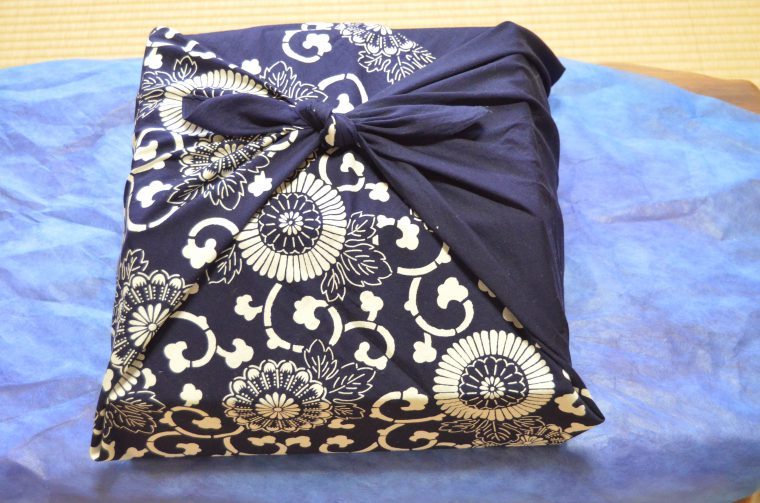
If you’d like the rabbits and frogs close at hand, here are three pieces that carry them: a cotton furoshiki, a tote bag, and a handkerchief.
- Musubi Furoshiki, Choju-giga Lotus Leaf (Turquoise, 100 cm)A wrapping cloth of frogs and rabbits from an old scroll.Furoshiki, Made in Japan
- Choju-giga Tote Bag (Maruzen, White)Choju-giga frogs, rabbits and monkeys on a cotton tote.Bags & hair, Made in Japan
- Choju-giga Handkerchief, Kyosai Series (Yamamoto Jin Shoten, Gray)Choju-giga rabbits and frogs, on a light cotton square.Furoshiki, Made in Japan
Keep reading
Show sources (30)
- Japan Post, special stamps for the Philanippon 2011 exhibition (2011): the scrolls “said to be Japan’s oldest manga,” printed beside other characters. (in Japanese)
- Kotobank, “Chōjū-giga” (Kyodo News glossary, Ōbunsha, Digital Daijisen and Sekai Daihyakka Jiten): “also said to be the origin of manga and animation,” no text in the scrolls, the attribution, whether the four are one series. (in Japanese)
- Kyoto National Museum, special exhibition 2014 (English page): the scrolls often mentioned as the first example of manga; scroll C’s two halves.
- Kyoto National Museum, special exhibition 2014 (Japanese page): the four repaired scrolls shown together. (in Japanese)
- nippon.com, “Chōjū Jinbutsu Giga” (2026): “is often regarded as an early precursor to modern manga”; the name.
- Kōzan-ji, temple treasures: the scrolls, the painters, how they came to the temple. (in Japanese)
- Kōzan-ji, temple treasures (English): the replica in the Sekisui-in hall; the artist unknown.
- Kōzan-ji, visiting information: opening hours and the temple’s own reading of its name. (in Japanese)
- Kōzan-ji, former official site: the painters named and none confirmed. (in Japanese)
- Anime News Network (2008): a Yomiuri Shimbun article on the scrolls and today’s manga.
- Ministry of Economy, Trade and Industry on Google Arts & Culture, “Is This The First Manga?” (2020, by Miyamoto Hirohito): the word manga, the 1895 preface, the 1924 history, the old designation. (in Japanese)
- Meiji.net (2018), Miyamoto Hirohito: when the scrolls came to be called the origin of caricature. (in Japanese)
- Iwanami Shoten, Hosokibara Seiki, Nihon Manga-shi (a history of Japanese manga): where the book starts Japanese manga. (in Japanese)
- Kotobank, “Manga” (Nihon Kokugo Daijiten and Nihon Daihyakka Zensho): free sketching, caricature, toba-e picture books from 1720. (in Japanese)
- National Diet Library Digital Collections, Shiji kōka (1798): pictures by Kitao Shigemasa, preface by Santō Kyōden. (in Japanese)
- Kotobank, “Chōjū-jinbutsu-giga” (Nihon Daihyakka Zensho): no text in the scrolls, the meaning of the scenes, the attribution, the four scrolls. (in Japanese)
- Masuki Ryūsuke, lecture notes (2023): the 1253 colophon, the 1519 and 1570 records, the painters, the paper. (in Japanese)
- Agency for Cultural Affairs, database of designated cultural properties: the official name, four scrolls, the owner, National Treasure in 1952. (in Japanese)
- National Diet Library, Collaborative Reference Database (2019): the scrolls at Kōzan-ji not traceable before the 1500s. (in Japanese)
- Japan National Tourism Organization, Kōzan-ji: the originals deposited with the national museums in Tokyo and Kyoto.
- Hobonichi (2021), interview with Tsuchiya Takahiro of the Tokyo National Museum: display days, and why the scrolls were drawn. (in Japanese)
- Tokyo National Museum, special exhibition 2021: all four scrolls, their dates and contents. (in Japanese)
- Nikkei (Kyodo, 2014): the four scrolls shown together for the first time in 33 years. (in Japanese)
- Nikkei (Kyodo, 2016): the repair report on scroll A’s sheets. (in Japanese)
- Tokyo National Research Institute for Cultural Properties, art-world chronology (2011): scroll C’s double-sided sheets.
- Kotobank, “Kakuyū” (Nihon Daihyakka Zensho, Sekai Daihyakka Jiten, Yamakawa and Digital Daijisen): the monk and his name, the tales of his skill, the attribution. (in Japanese)
- Kotobank, “Toba-e” (Nihon Kokugo Daijiten and Sekai Daihyakka Jiten): the word, in an example of 1706, named after Toba Sōjō. (in Japanese)
- Cultural Heritage Online, a fragment of scroll A (MIHO MUSEUM): no direct evidence that Kakuyū drew the scrolls. (in Japanese)
- Japan Search, “Detached Segment of Frolicking Animals” (Tokyo National Museum, ColBase): the fragment and the petals that place it in scroll A.
- Wikipedia (Japanese), “Chōjū-jinbutsu-giga”: the A–D order from a 1931 publication. (in Japanese)