Tabi Socks: The Split Is for the Strap
You own the sandals, or the split-toe shoes. Here is what the socks do, which kind matches what you will wear, and how to size them.
This column was written by AI from the sources listed below. Sakinome decides what is published.
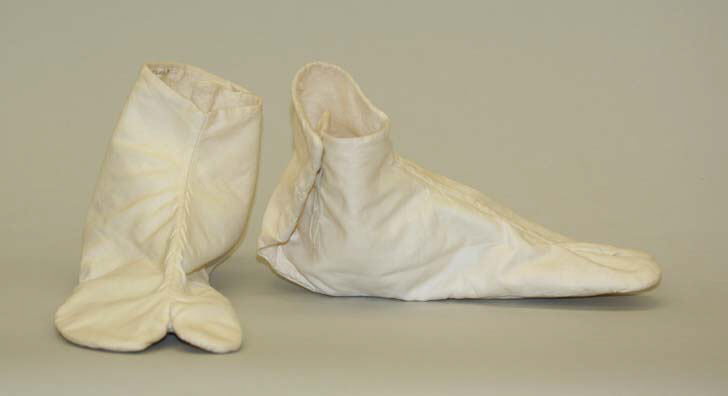
You own a pair of thong sandals, or a pair of split-toe boots of the kind Martin Margiela showed in 1988, and you are at the sock drawer wondering what goes on your feet with them. For the sandals, the answer is a tabi sock, made for a strap like theirs; the boots get their answer a few lines down. The big toe gets a pocket of its own and the other four share one, like a mitten for the foot. The gap between them is shaped to fit the thong strap of and , the Japanese sandals held on by a strap between the toes.
So, do you need them? If what you own is a sandal with a strap between the toes, the sock is shaped for that strap. If what you own is a split-toe shoe, two makers of those shoes have already answered for you. Marugo, a footwear maker in Kurashiki, stocks tabi socks in its own tabi-shoe store to pair with the shoes, and keeps pairs on hand for customers to wear while trying shoes on. Kineya, a tabi maker in Gyoda, tells buyers of its running tabi to choose a size 7–10 mm (about 0.3–0.4 in) longer than your measured foot length when socks will be worn underneath. Kineya also recommends socks in the same color as the shoe, because the leather at the heel can give off dye. If what you own is an ordinary closed shoe, nobody will stop you: a sock maker sells tabi-shaped foot covers for pumps.
The split is for a strap
Museums in London and Japanese reference works say the same thing: the split exists for the hanao, the strap of those sandals. On a zori the sole is flat; on a geta it is a wooden board on raised teeth, with the strap threaded through three holes. The split in the sock leaves room for that strap.
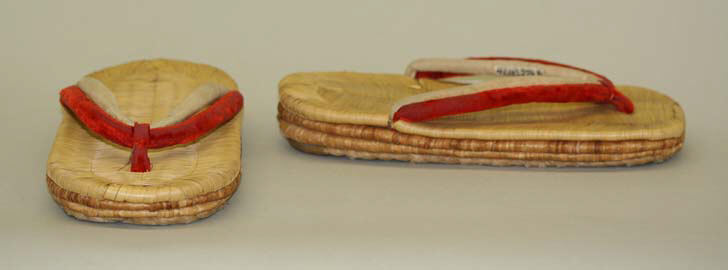
With only one split, a tabi sock is easier to put on and take off than a five-toe sock, as a tourism office in Okayama points out. Fukusuke, a tabi maker, knits a padded top into its tabi tights so the strap digs in less. And the shop at Japan House London sells tabi socks made to be worn with geta, sourced from Japanese sock makers.
Three kinds you will meet
The word covers more than socks. Three kinds turn up when you shop, and the right one depends on where your feet are going.
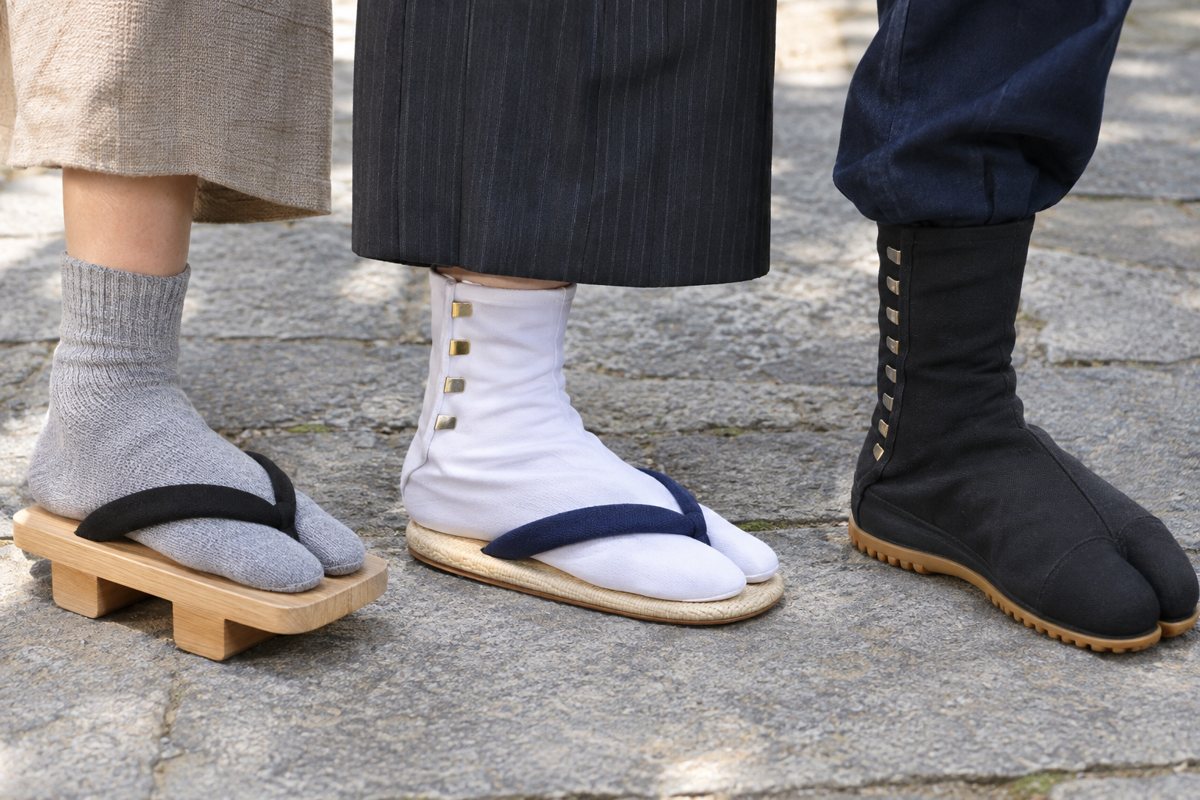
Three kinds of tabi
| Tabi socks | Kohaze tabi | Jika-tabi | |
|---|---|---|---|
| What it is | A knitted sock with the big toe split off; made in nylon, wool and cotton blends | Sewn cloth, mostly 100% cotton, closed at the heel with metal clasps called | A tabi with a rubber sole, worn directly on the ground |
| Fastening | Pulls on like any sock | Four or five clasps are common; there is no formal rule | Five, seven, ten or twelve clasps, for example, so the ankle can be closed tight |
| Where it’s worn | Under sandals with a thong strap; under split-toe shoes; also sold for closed shoes | With a kimono, white for formal occasions; on the noh stage | Construction, shipbuilding and civil engineering; gardening; festivals |
| Pick it if | You own thong sandals or split-toe shoes | You will wear kimono to a formal event or a tea gathering | You work outdoors or in a garden, or will join a festival |
The name itself does not say much. The two characters of tabi mean “foot bag.” One explanation says early tabi were leather and were written with characters meaning “single skin.” Cloth tabi were once tied at the ankle with cords; now they close with kohaze, clasps of nickel-plated brass.
Jika-tabi, the rubber-soled kind, take their name from treading the ground directly. They were born in the city of Kurume in the early 1920s, and one account says demand grew with the rebuilding of Tokyo after the earthquake of 1923.
Picks: tabi socks
Both are made in Japan: Otafuku’s 100% cotton split-toe socks, from a work-glove maker founded in 1926, are cut for zori and geta, and Marugo’s festival socks add a non-slip finish on the sole for wearing under jika-tabi.
Where each kind goes today
Kineya’s own guide sorts tabi by what you will be doing, and that is the quickest way in:
- Indoors, in everyday clothes: navy or black cloth tabi.
- Walking or running: running tabi.
- Garden or farm work: jika-tabi.
Dress adds a color rule. For a formal occasion, white tabi are the custom. With a kimono worn for your own pleasure, Fukusuke says white or black, as you like; men’s everyday tabi are often navy or black. At a tea gathering you change out of the tabi you walked in, so a spare pair rides in the bag.
Noh theater and sumo each have footwear rules of their own. On the stage, actors, chorus and musicians all wear white tabi, at rehearsal too; bare feet and socks are not allowed. In sumo, a referee’s rank decides what goes on his feet: the top grades wear tabi with zori, the middle grades tabi alone, and the lower grades go barefoot.
Outdoors, jika-tabi still go to work. One encyclopedia lists them as essential in civil engineering, shipbuilding and construction, and nippon.com describes construction workers and gardeners wearing them for solid footing. Marugo’s footwear division makes tabi just for festivals, down to children’s sizes.
Running has its own thread. Shisō Kanakuri, a marathon runner, ran the 1912 Olympic marathon in Stockholm in marathon tabi made by a tabi shop in his neighborhood. In 1951 Shigeki Tanaka, aged 19, won the Boston Marathon in a shoe shaped like a tabi. When Onitsuka, the company that became Asics, put out its own marathon tabi in 1953, tabi were still the normal footwear at sports meets in Japan.
Wearing tabi was not always a personal choice. Samurai society had a rule, recorded in an old manual, that allowed tabi only from October 1 to February 20, and only to those aged fifty and over. A younger man needed his lord’s permission even when ill, a release called . The rule held until 1862. You may skip the permission.
Sizes: measure in cm first
Tabi sizes are given in centimeters of foot length, and makers give different advice on which number to pick. Kineya builds its cloth tabi and jika-tabi on the Japanese shoe-size standard, so its guide is your shoe size, roughly foot length plus about 5 mm (0.2 in). Fukusuke’s guide is about 0.5 cm (0.2 in) smaller than your shoe size, because a tabi looks neat when it fits without wrinkles. For first-time wearers, Fukusuke suggests a stretch fabric. The safe road through both: measure your foot in centimeters and choose by the cm label on the product.
Marugo says measure both feet and, if they differ, go with the larger; the longest toe is not the same toe on everyone. One retailer suggests this way to measure: stand on a sheet of paper, trace the foot, measure heel to longest toe in cm, and round up to the next size. Fukusuke’s cloth tabi come in 0.5 cm (0.2 in) steps, and its calico line in five fit shapes and more than a hundred size variations by width and instep height. A four-clasp pair and a five-clasp pair are sized differently, so check the size again when you switch. Only its nylon stretch tabi use S, M and L.
To picture one: a white cotton tabi at the Victoria and Albert Museum in London, made around 1960, is 26 cm (10.2 in) long and 13.5 cm (5.3 in) high. It was part of a kimono set given to a member of the British royal family by a daughter of the emperor of Japan. Sizes were once counted in , the diameter of a one-mon coin, about 2.42 cm (0.95 in). Today the label just says cm.
Care, and one thing to do next
Cloth tabi: wash early, before dirt settles. Use warm water and a brush on the marks. In a machine, run a gentle cycle for about five minutes, in a mesh bag if you have one. No chlorine bleach. Dry in the shade. Kineya adds a trick: wash them while wearing them and they settle into the shape of your foot. Afterward, hold toe and heel, pull the shape straight, and skip the dryer, which shrinks them. For the iron, follow the maker’s label.
Knitted tabi socks follow sock rules; Muji’s label says no optical-brightener detergent on light colors, and wash dark colors on their own. Jika-tabi, according to an article written with input from Marugo, stay out of the washing machine, which can warp them or loosen the sole; dry them in an airy, shaded spot.
Honest notesFit and care cautions
- Kineya says its cloth tabi may shrink lengthwise with washing, depending on how they are dried: around 5 mm (0.2 in) from the fourth or fifth wash, and up to about 7 mm (0.3 in) after the tenth. Source: Kineya Tabi (in Japanese)
- The non-slip rubber on the sole of SOU·SOU’s stretch tabi can leave colored marks on light-colored enamel or synthetic-leather zori. Source: SOU·SOU
- Stretch tabi should be your usual size or a little larger; SOU·SOU warns that a tight pair can tear at the heel. Source: SOU·SOU
- Nylon tabi covers, worn over tabi to keep them clean, are slippery, and the dirt they pick up ends up on the kimono hem. Source: Heibonsha World Encyclopedia (in Japanese)
Tonight, take the sandals or the split-toe shoes out of the closet, measure both feet heel to longest toe in centimeters, and write down the larger number. That number is what you carry to the product page.
Picks for this column
Three more from Japanese makers: CW-X split-toe socks for runners and walkers, from a Wacoal brand built around the idea of sports taping; Wafuka’s tabi socks covered in red daruma dolls; and ISM’s zori with a woven-rush footbed and a cat-patterned strap.
- CW-X Tabi Socks with Ankle Support, ShortJapan-made split-toe socks with ankle and arch support.Footwear, Made in Japan
- Wafuka Split-Toe Tabi Socks, Koron DarumaSplit-toe tabi socks from Japan, red daruma all over.Footwear, Made in Japan
- ISM Aizome Tatami Zori, Kutsurogi Neko (Size L)Tatami-topped zori with a cat-pattern strap. Size L.Footwear, Made in Japan
Keep reading
Show sources (36)
- Kotobank, “Tabi” (Nihon Daihyakka Zensho and other reference works): the split and the thong strap, ankle cords and clasps, the old size unit, colors for formal and everyday wear, tea gatherings, the samurai rule, knitted tabi socks, tabi covers. (in Japanese)
- Kotobank, “Jika-tabi”: the meaning of the name, clasp counts, demand after the 1923 earthquake, work that still uses them. (in Japanese)
- Kotobank, “Hanao”: the strap held between the toes. (in Japanese)
- Kotobank, “Zori.” (in Japanese)
- Kotobank, “Geta.” (in Japanese)
- Kotobank, “Gyōji”: what sumo referees wear on their feet by rank. (in Japanese)
- Victoria and Albert Museum, a pair of tabi, about 1960: the toe divide and the shoes, size, the gift.
- Horniman Museum, tabi socks: the split so they can be worn with geta and zori.
- The Museum at FIT, Martin Margiela Tabi boots: the 1988 date.
- Okayama Prefecture tourism site: Marugo’s tabi-shoe store and its tabi socks; tabi socks and five-toe socks.
- Kineya Tabi, Toe-Bi running tabi: sizes with socks, the heel leather. (in Japanese)
- Kineya Tabi, what tabi are: the toe split, cloth, choosing by use, washing while wearing. (in Japanese)
- Kineya Tabi, how tabi are made: the clasps. (in Japanese)
- Kineya Tabi, history: where the company is. (in Japanese)
- Kineya Tabi, sizes: the shoe-size standard, shrinking after washing. (in Japanese)
- Fukusuke online shop, about tabi: clasp counts, sizes, colors, washing, ironing, stretch tabi. (in Japanese)
- Fukusuke online shop, recommended tabi: tabi tights, size steps, shapes. (in Japanese)
- Fashionsnap, 2020: tabi-shaped foot covers for pumps. (in Japanese)
- Japan House London shop, tabi socks to wear with geta.
- Muji Canada, tabi short socks: materials and washing label.
- SOU·SOU, stretch tabi: the non-slip sole and color transfer, sizing.
- Kurume City, local history sheet: jika-tabi in Kurume in the early 1920s. (in Japanese)
- the-noh.com: white tabi on the noh stage. (in Japanese)
- nippon.com, “Tabi”: who wears jika-tabi.
- Marugo, footwear business: festival tabi, including children’s. (in Japanese)
- Marugo, English site: the characters of tabi.
- Marugo online shop, festival socks: the non-slip sole. (in Japanese)
- Marugo online shop, foot size: measuring both feet. (in Japanese)
- Tabis Online Japan, sizing: tracing the foot on paper.
- web Sportiva (Shueisha), 2017, page 1: Kanakuri’s marathon tabi in 1912. (in Japanese)
- web Sportiva (Shueisha), 2017, page 3: Tanaka’s 1951 Boston win in tabi-shaped shoes. (in Japanese)
- The Harvard Crimson, April 20, 1951: Tanaka’s Boston win.
- Asics, history: the 1953 marathon tabi and tabi at sports meets.
- Mynavi Agri, an article made with Marugo’s cooperation: caring for jika-tabi. (in Japanese)
- The Metropolitan Museum of Art, “Tabi” (C.I.53.66.2a, b): the top photo, public domain.
- The Metropolitan Museum of Art, “Zori” (C.I.41.110.274a, b): the zori photo, public domain.