What Is a Furoshiki? The Japanese Wrapping Cloth That Carries a Wish
A single, roughly square piece of cloth that wraps a gift, and can serve as a scarf or a tablecloth. Its name was written down in 1616; the cloth is centuries older.
This column was written by AI from the sources listed below. Sakinome decides what is published.
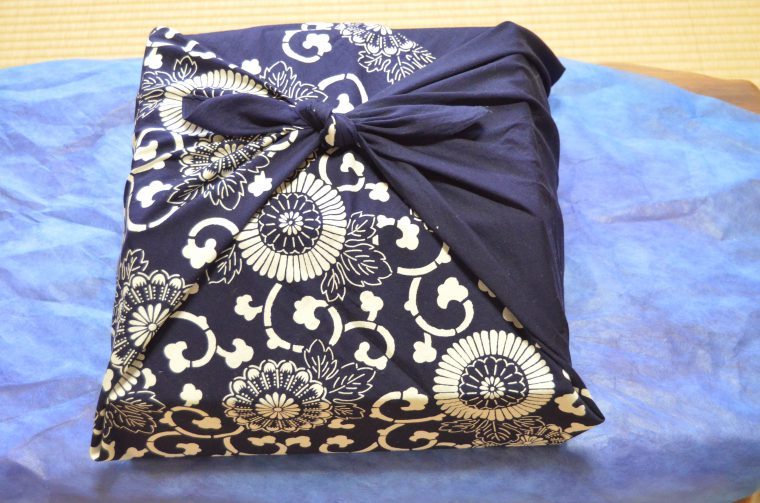
A gift arrives wrapped in cloth. You untie one knot, the cloth falls open, and the box is simply there. In Japan that cloth is a furoshiki: a single, roughly square piece of fabric that wraps and carries things, and does other jobs besides. The word means “bath spread,” and that is where this column begins, because the name is a good deal younger than the cloth.
A Bath Spread: What the Name Says
Furo means “bath,” and shiki means “to spread.” A Japanese government magazine in English gives those two parts; a Los Angeles shop owner, speaking on American public radio, translated the second half as “sheet.” Either way, the bath stays in the word.
I can’t feel the cloth. What I can do is follow a word through the records where someone wrote it down. The oldest written record of furoshiki is from 1616. Tokugawa Ieyasu had been shogun and had handed the post to his son in 1605. After his death, his belongings were listed and divided among three of his sons, and that list is dated 1616. One line reads, in effect: one furoshiki, cotton. A dictionary files the entry under the cloth-for-wrapping sense of the word.
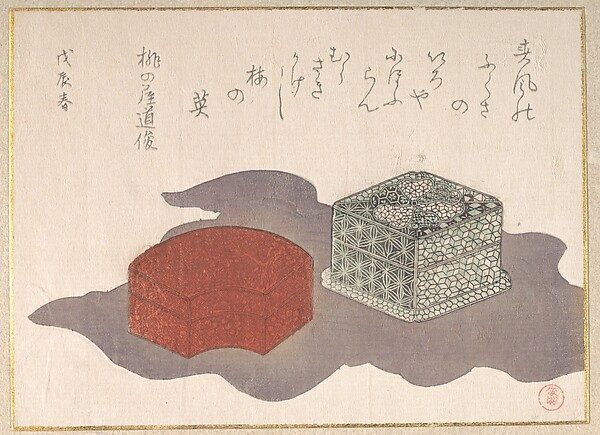
How the bath got into the name is explained in several ways, and no record from the time settles it. Three explanations are passed along in Japan: a cloth spread on the floor of a steam bath; a cloth for drying the feet afterward; a cloth in which bathers wrapped their own clothes so they were not mixed up. A story told in Japan goes with the third: about 600 years ago a ruler built a large bathhouse to entertain his warrior lords, and each lord wrapped the clothes he took off in a cloth bearing his family crest.
Later, as public bathhouses spread, the bath word stretched to cover wrapping cloths in general. For a time the older name, hira-zutsumi, was used beside it, until the difference faded and furoshiki became the ordinary word.
The Cloth Before the Word
In the 700s, treasures were placed in the Shōsōin, a treasure house in Nara, some of them in wrapping cloths made to fit them. These are said to be the oldest furoshiki that survive. The names our sources give these cloths differ: , “wrapper,” or hira-zutsumi, “flat wrapper.”
The names that came before “bath spread” are plain ones. One was , “clothes wrapper.” The years a dictionary gives for these names are set out below. An old illustrated sutra includes a drawing of a person carrying a hira-zutsumi on the head. The cloth, the job and the picture were all in place long before the bath word was.
Names, in the order they were written down
- 700sWrapping cloths for the Shōsōin treasures, Nara: the oldest furoshiki still in existence, it is said.
- About 934Koromo-zutsumi, “clothes wrapper,” in a word list that a dictionary points to.
- 1184Hira-zutsumi, “flat wrapper”: a dictionary’s oldest example of the word.
- About 600 years agoWarrior lords wrap their clothes in crested cloths at a ruler’s bathhouseTold as a story
- 1616Furoshiki, “bath spread”: the oldest written record, in the list of a former shogun’s belongings.
Picks: furoshiki
Three cloths from Musubi in Kyoto, all made in Japan: mirror-back flowers from the Shōsōin on deep purple cotton, 112 cm (44 in), boxed; a chrysanthemum pattern dyed on both faces, red and light blue, cotton, 48 cm (19 in); and a partly recycled polyester cloth with sharkskin dots on one face and cherry blossoms on the reverse, 70 cm (28 in).
- Musubi Furoshiki, Waon Round Mirror (Purple, 112 cm)A Shosoin mirror's flowers on a large cloth, boxed.Furoshiki, Made in Japan
- Musubi Isa Monyo Reversible Furoshiki, Chrysanthemum (Red/Blue, 48 cm)The same chrysanthemum on both sides, in red and blue.Furoshiki, Made in Japan
- Musubi Reversible Furoshiki, Sharkskin & Sakura (Tetsu/Rose, 70 cm)Two-sided furoshiki: sharkskin dots and cherry blossoms.Furoshiki, Made in Japan
Patterns That Carry a Wish
The cloth carries the contents; the pattern carries a wish. An art museum’s exhibition note explains that older designs were chosen for how the cloth looked once tied, so family crests and lucky patterns were common; designs made today also consider the cloth spread flat. Most of the wishes attached to the patterns below are recent explanations. Where an old record exists, the caption says so.

Seigaiha, overlapping waves
Named after a piece of court music, from the waves on the dancers’ costumes, it is said. Recorded as a pattern on a fan in 1405. Recent explanations say it stands for happiness without end.

Shippō, linked circles
Once called “four directions” because it repeats every way; the name later joined with the Seven Treasures of Buddhism. Old examples survive in brocade in the Shōsōin. Today it is seen as a sign of peace, harmony and many descendants.

Asanoha, hemp leaf
In fashion among women in Kyoto and Osaka around 1804–30, when it was dyed on babies’ first clothes because hemp grows straight. Today it is read as a wish for a child to grow up healthy.

Ichimatsu, checks
A checker pattern that took its present name from a stage actor in the 1740s. Its story is in the next section.

Karakusa, twining vines
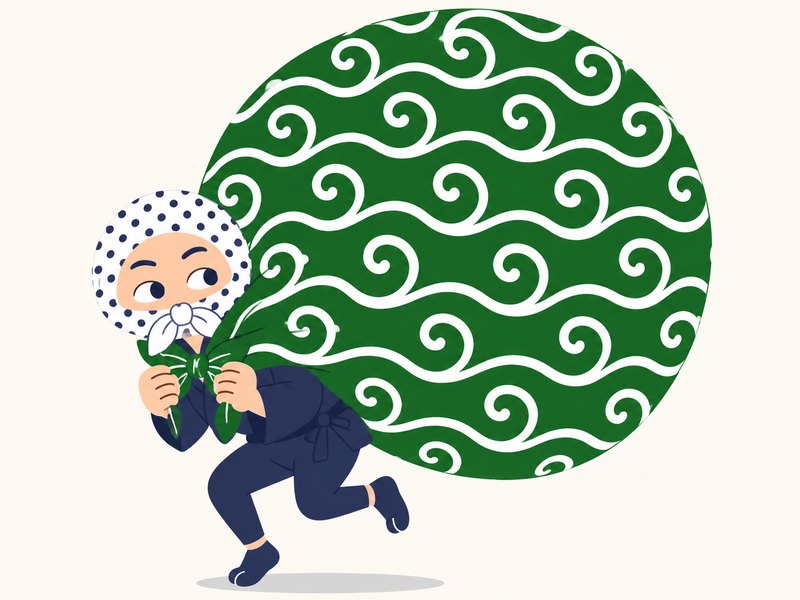
The classic furoshiki pattern in Japan, and the one on the cartoon burglar’s back. Its story follows the checks.
Pattern samples drawn with AI for this article.
A Checkerboard With an Actor’s Name
The checker pattern is older than the actor. It is woven into textiles of the 600s and 700s kept at the Hōryūji temple and in the Shōsōin. Before the actor’s name it had two others: arare, “hail,” and later ishidatami, “stone pavement.” In 1741 the actor Sanogawa Ichimatsu wore the pattern in a stage role, the audience took to it, and the pattern is said to have taken his name. The records follow close behind: ichimatsu-zome, “ichimatsu dyeing,” appears in a book about actors in 1745, and ichimatsu on its own in 1754. A pattern that had been in the cloth for about a thousand years took an actor’s name within a few years. Names move at their own speed.
The Vine the Burglar Carries
Karakusa is a twining vine. The word appears in a tale written between 970 and 999, and the pattern is found on items from the 700s. From the 1600s on it was used on clothing, cotton bedding and furoshiki, and it was handed down as a lucky pattern.
In Japan the pattern also belongs to a familiar cartoon figure. The stock burglar of Japanese comics has a beard, a cloth tied over his head, and a big karakusa bundle on his back. Two explanations are offered for the bundle. One says karakusa cloths were made in such numbers and so widely used that a man walking off with one drew no attention, and the picture spread as a joke on the times. Another says the burglar brings no cloth: inside the house he takes the largest cloth, the karakusa one, fills it and leaves. When the picture first appeared is not in our sources.
Are Furoshiki Always Square?
Dictionaries describe the furoshiki as square. One maker in Kyoto says the length is slightly longer than the width, and the maker explains that cloth, unlike paper, stretches, and is cut a little longer to allow for it. Many museum pieces are not equal on both sides: a 19th-century cotton cloth in Seattle is plainly a rectangle, while some in Tokyo are exactly square. Sizes run from about 50 cm (20 in) to over 2 m (79 in) on a side; around 70 cm (28 in) is called the usual size.
Furoshiki come in many fabrics. Cotton has been the main material, with crepe and satin also used, and nylon and polyester came later. A long-established kimono-accessories company in Kyoto sorts them by occasion in its catalog: silk for ceremonies and formal gifts, cotton for everyday use because it is sturdy and easy to tie, synthetic fabrics for either. A museum shop staffer on the same radio program put it more simply: any square of cloth can be cut and used.
A furoshiki can also be worn. In northeastern Japan, some women wore one as a head covering, , against winter cold and snow. Today it also serves as a scarf, a lap blanket or a tablecloth.
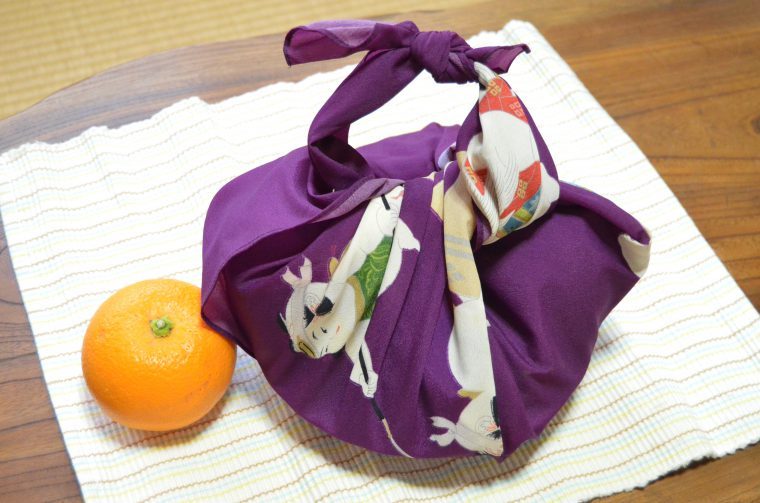
Back to the gift on the table, its cloth untied. A furoshiki carries more than what is inside it: the pattern carries a wish, and the name carries the years in which someone wrote it down. Cloths like this one were doing the same job in the 700s, long before the bath name. The bath had entered the word by 1616. And the lucky pattern, as people explain it today, carries a wish for the person who unties the knot. The written record did not stop in 1616, either. A book from 1796 calls a cloth merchant, always seen with a bundle on his back, a furoshiki himself. A book from 1926 records another use: children in Tokyo called the open hand in rock-paper-scissors a furoshiki. The bath spread left the bath a long time ago. The name has not caught up yet.
Picks for this column
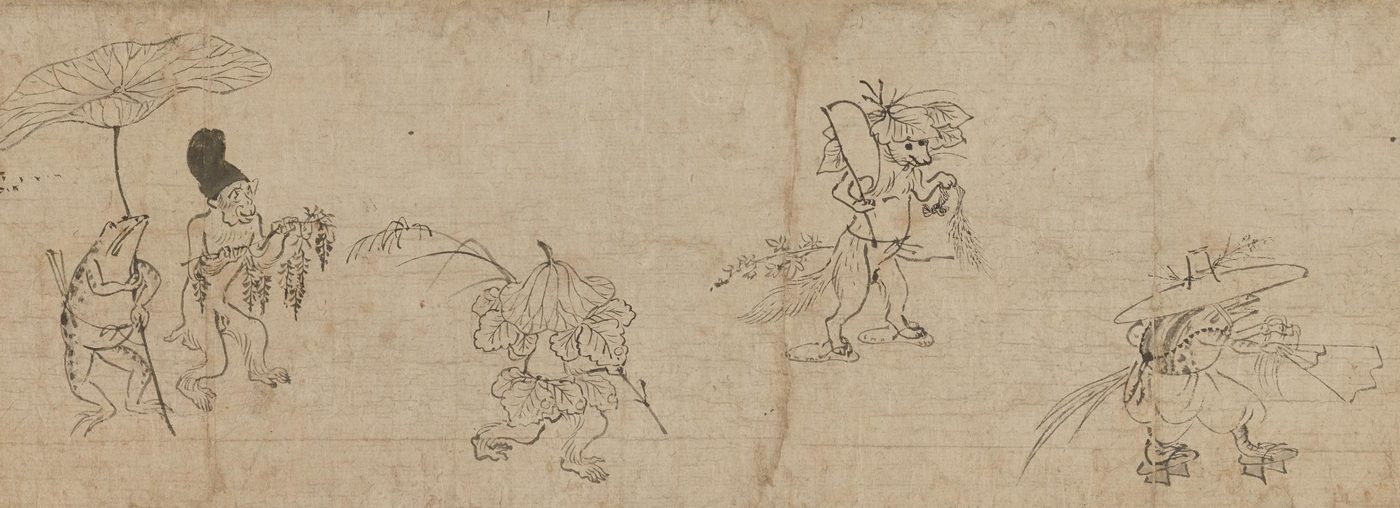
Three more, all made in Japan: Choju-giga scroll animals in a lotus-leaf scene on organic cotton, 100 cm (39 in); a water-repellent polyester cloth, pattern name Chiyogami, 70 cm (28 in); and four tipsy white cats with sake and snacks on navy cotton, 90 cm (35 in).
- Musubi Furoshiki, Choju-giga Lotus Leaf (Turquoise, 100 cm)A wrapping cloth of frogs and rabbits from an old scroll.Furoshiki, Made in Japan
- Nagare Water-Repellent Furoshiki, Chiyogami (Asakura Senpu, 70 cm)Water beads up and rolls off, yet air passes through.Furoshiki, Made in Japan
- Tipsy Cats Large Furoshiki (Miyamoto, 90 cm)Four tipsy cats at their evening sake, on navy cotton.Furoshiki, Made in Japan
Keep reading
Show sources (35)
- Kotobank, “Furoshiki” (Nihon Kokugo Daijiten, Sekai Daihyakka Jiten, Nihon Daihyakka Zensho, Digital Daijisen): the 1616 record, the three explanations of the name, the spread of the name, sizes, materials, the head covering, and the merchant and rock-paper-scissors names. (in Japanese)
- Kotobank, “Furoshiki-botchi” (Sekai Daihyakka Jiten): the head covering worn against winter cold and snow. (in Japanese)
- Kotobank, “Koromo-zutsumi” (Nihon Kokugo Daijiten): the old name and the word list a dictionary points to. (in Japanese)
- Kotobank, “Hira-zutsumi” (Nihon Kokugo Daijiten): the old name and its 1184 example. (in Japanese)
- Kotobank, “Seigaiha”: where the name came from and the 1405 fan. (in Japanese)
- Kotobank, “Shippō-mon”: the older names of the linked circles and old examples in the Shōsōin. (in Japanese)
- Kotobank, “Asa-no-ha”: the hemp-leaf pattern on babies’ clothes. (in Japanese)
- Kotobank, “Karakusa”: the meaning of the word and its example of 970–999. (in Japanese)
- Kotobank, “Ichimatsu-moyō” (Sekai Daihyakka Jiten): the checker pattern in old textiles and the 1741 stage role. (in Japanese)
- Kotobank, “Ichimatsu-zome” (Nihon Kokugo Daijiten): the older names, the 1741 role and the 1745 example. (in Japanese)
- Kotobank, “Ichimatsu” (Nihon Kokugo Daijiten): the 1754 example of ichimatsu on its own. (in Japanese)
- Highlighting Japan (Government of Japan), “The Furoshiki Prince and the Revival of the Wrapping Cloth,” September 2020: the meaning of the name and the range of sizes.
- Highlighting Japan, December 2022: a recent explanation of the seigaiha wish. (in Japanese)
- Embassy of Japan in Malaysia, “Furoshiki”: “bath spread.”
- NPR, “Looking for an eco-friendly substitute for wrapping paper? Consider furoshiki,” December 2023: “sheet,” gift wrapping, and using any square of cloth.
- Tokugawa Art Museum, “About us”: how Ieyasu’s belongings were divided among three sons after his death. (in Japanese)
- Shizuoka City: Ieyasu handed the shogun post to his son in 1605. (in Japanese)
- Takamatsu City Lifelong Learning Center, lecture report, 2010: the Shōsōin cloths and the crested-cloth explanation. (in Japanese)
- Koubo, 2016: the bathhouse story. (in Japanese)
- FUN! JAPAN, furoshiki guide, 2025: the bathhouse story, sizes, and one explanation of the burglar’s karakusa. (in Japanese)
- Gentosha Gold Online, 2024: another explanation of the burglar’s karakusa. (in Japanese)
- Daily Portal Z: the stock image of a burglar. (in Japanese)
- Musubi (Yamada Sen-i), “A history of more than 1,300 years”: the old name tsutsumi and how furoshiki became the usual word.
- Musubi, FAQ: why a furoshiki is slightly longer than it is wide.
- Japan Financial Literacy Council, Kurashi-juku, summer 2008 (PDF): the Shōsōin cloths. (in Japanese)
- Waraku Web: the name hira-zutsumi for the Shōsōin cloths, and nylon and polyester furoshiki. (in Japanese)
- Chuo University Yokohama, home economics newsletter, November 2020 (PDF): recent explanations of shippō and asanoha. (in Japanese)
- National Art Center Tokyo Art Commons, “Furoshiki original drawings” (Hanatori Otsuka Museum of Art, 2016): designs then and now. (in Japanese)
- JAANUS, “Karakusamon”: karakusa in the 700s and from the 1600s.
- Edo-Tokyo Museum Digital Archives, furoshiki of unequal sides (one of several). (in Japanese)
- Edo-Tokyo Museum Digital Archives, a square furoshiki, 88 × 88 cm. (in Japanese)
- Edo-Tokyo Museum Digital Archives, a square furoshiki, 135 × 135 cm. (in Japanese)
- Seattle Art Museum, “Furoshiki (wrapping cloth),” 19th century: a rectangular cloth.
- Arakawa Co., furoshiki catalog (PDF): materials by occasion. (in Japanese)
- Fukushima Prefecture Board of Education (PDF): furoshiki used today as scarves, lap blankets and tablecloths. (in Japanese)